Category: Buying Guides

  • Custom Clappers: Pricing, MOQs & Lead Times (2026)

    If you’re outfitting a student section, a corporate booth, or a wedding send-off line, custom clappers are one of the cheapest ways to put your logo in someone’s hand for the length of an entire event. They’re loud, they’re inexpensive to produce, and unlike a t-shirt or tote bag, almost nobody already owns one — so the branding doesn’t compete with anything else in the room. But before you send art over to a supplier, it helps to know what you’re actually going to pay, because pricing on these things swings more than you’d expect based on shape, quantity, and how many print locations you want.

    This guide uses current, published pricing and minimum order quantities from several promotional products suppliers so you can budget accurately and avoid the two most common surprises: a setup charge that wasn’t included in the “per unit” price you saw first, and a minimum order quantity higher than what you actually need.

    What custom clappers actually are

    A “clapper” in the promotional products world is a hand-held noisemaker made of two flat paddles (usually corrugated plastic or dense foam board) joined at a hinge, so a single downward motion snaps them together for a sharp crack. They’re distinct from clackers (the two-ball string toy) and from thunder sticks (inflatable tubes you bang together) — clappers are flat, foldable, and print like a business card, which is exactly why they’re cheap to brand.

    Most suppliers offer three general shapes: a rectangular “hand clapper” paddle, a round or oval clapper, and novelty shapes molded like a baseball, football, star, or megaphone. The rectangular paddle is the cheapest to produce because the print area is a flat, simple die-cut; shaped clappers cost more because the tooling and trim work is more involved.

    Custom clappers print in one to four spot colors or full color (CMYK) on one or both paddle faces. A single-color, one-side imprint is the standard low-cost configuration quoted on most price lists; adding a second side or a second ink color raises both the per-unit price and the setup charge.

    How custom clapper pricing breaks down by quantity

    Pricing on custom clappers follows the usual promo-product curve: a fairly flat per-unit price with small step-downs at set quantity tiers, plus a one-time setup charge that doesn’t change with volume. The setup charge is why small orders feel expensive per piece — it gets divided across fewer units.

    PromotionChoice’s custom round clapper (7 inches long, 3-inch diameter print face) publishes a clean example of this curve: $1.15 per piece at 250 units, $1.13 at 500 units, and $1.11 at 1,000 units, plus a $0.25 run charge per quantity tier. That’s a roughly 3.5% price drop across a 4x quantity increase — not a reason to over-order.

    4imprint’s rectangular Hand Clapper (White Handle) starts at a 150-piece minimum with pricing from $0.69 to $1.35 depending on quantity, and its molded Round Of Applause Clapper starts at a 250-piece minimum, pricing $0.82 to $1.45. Both carry a separate $55–$60 setup charge per imprint location, billed once regardless of quantity.

    Round clapper pricing barely moves past 250 units — the run charge, not the unit price, is what shrinks as you order more.Price per unit ($): $1.15 to $1.11$0.00$0.38$0.75$1.12$1.50250 units500 units1,000 unitsPrice per unit ($)
    Round clapper pricing barely moves past 250 units — the run charge, not the unit price, is what shrinks as you order more.Source: PromotionChoice.com, Custom Round Clappers / Printed Noisemakers product page, fetched August 2026

    Comparing minimum order quantities across suppliers

    Minimum order quantity is often the more important number than unit price, especially for a single event or a small team order. It varies more between suppliers than the price does.

    4AllPromos sets its general noisemaker minimum at 96 pieces starting around $0.93 each, but its dedicated Hand Clapper line has a 250-piece minimum with pricing as low as $0.73 at volume. 4imprint’s rectangular hand clapper starts at a 150-piece minimum, while its molded and novelty-shaped clappers (baseball, football, round) start at 250 pieces. If your headcount is under 100, 4AllPromos’ general noisemaker minimum is the one worth checking first — most other suppliers won’t quote below 150–250 units for a clapper.

    Minimum order quantities and starting per-unit prices vary by supplier and clapper style — check the MOQ before you fall for the low per-unit price.
    Supplier Style MOQ (pieces) Starting price/unit
    4AllPromos General noisemaker 96 $0.93
    4AllPromos Hand Clapper 250 $0.73
    4imprint Hand Clapper (rectangular) 150 $0.69
    4imprint Round Of Applause Clapper 250 $0.82
    PromotionChoice Round Clapper 250 $1.11–$1.15
    Minimum order quantities and starting per-unit prices vary by supplier and clapper style — check the MOQ before you fall for the low per-unit price.Source: Supplier product pages: 4allpromos.com, 4imprint.com, promotionchoice.com, fetched August 2026

    Setup charges, print locations, and what adds cost

    The per-unit price you see quoted is almost always for a single ink color on one side of the paddle. Two changes push the total up: adding a second print location (the back of the paddle) and adding ink colors beyond one. At 4imprint, each additional imprint location carries its own $55–$60 setup fee on top of the base charge — so a two-side imprint on a small run can add $1 or more per unit once that fee is spread across the order.

    If your logo is one color and you only need it on one face, say so explicitly when requesting a quote — some suppliers default to quoting multi-color art unless told otherwise, which inflates the number you see first.

    Lead time and rush options

    Standard production on custom clappers runs 5–7 business days after you approve a proof, according to 4AllPromos’ published production schedule — and that clock starts only once artwork is approved, not when you place the order. Build in a day or two for the proofing back-and-forth before production even begins.

    If you’re working against an event date, some suppliers — 4imprint among them — offer a 24-hour rush production option on select clapper styles for an added fee. Rush shipping (overnight or 2-day) is a separate cost from rush production, so a truly last-minute order can mean paying for both.

    A safe rule for planning: request your proof at least two weeks before you need product in hand. That covers a few rounds of art revisions, standard production, and ground shipping without paying rush fees.

    Choosing the right clapper for your event

    For a straightforward budget order — company picnic, spirit week, trade show giveaway — the rectangular hand clapper paddle is the right call. It’s the cheapest per-unit option, has the lowest minimums among the shaped styles, and the flat print area shows a logo cleanly without any distortion from molding.

    If you’re branding for a specific sport (a school athletics program, a Little League team), the molded baseball or football-shaped clappers read as more intentional merchandise than a generic paddle, and the price premium over the rectangular style is modest. For weddings, galas, or anything where the object doubles as a keepsake, the round or star-shaped clapper looks less like a stadium giveaway and more like a printed favor.

    Whatever the shape, keep the imprint simple. A clapper gets used for seconds at a time and then either kept in a bag or thrown away — a clean one-color logo and event name reads better at a glance than small text or a busy multi-color design that won’t be legible once the paddle is in motion.

    Frequently asked questions

    What’s the cheapest way to order custom clappers?

    Stick to the rectangular paddle-style hand clapper with a single-color, one-side imprint. Shaped clappers (baseball, football, star) and multi-color or two-side prints both add cost — the flat single-color paddle is consistently the lowest per-unit price across suppliers, starting around $0.69–$0.73 each at volume.

    How many custom clappers do I need to order minimum?

    It depends on the style and supplier. General noisemaker minimums start as low as 96 pieces at some suppliers, while dedicated hand clapper and round clapper lines typically start at 150–250 pieces. If your headcount is under 100, check general noisemaker minimums rather than the dedicated clapper product line, which often has a higher floor.

    Do custom clappers include the setup fee in the listed price?

    Usually not. The per-unit price quoted on most supplier sites covers only the item and printing labor; the one-time plate/setup charge (commonly $55–$60 per imprint location at suppliers like 4imprint) is billed separately. Ask for an all-in total, not just the per-unit price, before you commit to a quantity.

    How long does it take to get custom clappers made and shipped?

    Plan on 5–7 business days of production after you approve your art proof, plus shipping time. Rush production (as fast as 24 hours at some suppliers) is available on select styles for an added fee, and is billed separately from rush shipping.

    Can I print on both sides of a custom clapper?

    Yes, most suppliers offer a second print location, but it’s an add-on — expect an additional per-location setup charge plus a modest per-unit increase. For a small order, printing one side only keeps the total cost meaningfully lower.

    The bottom line

    Custom clappers are one of the few promotional items where the sticker price you see first is genuinely close to what you’ll pay — there’s no fabric, no color-matching, no size-run complexity. The variables that actually move your total are quantity tier, print locations, and which supplier’s minimum order quantity fits your headcount. Get a firm all-in quote (unit price plus setup, not just the per-piece number) before you commit, and order the rectangular single-color paddle unless you have a specific reason to pay more for a molded shape.
  • Custom Clappers: Materials, Sizing & Branding Guide

    Custom Clappers: Materials, Sizing & Branding Guide

    Custom Clappers: A Materials, Sizing, and Branding Guide

    Getting custom clappers right comes down to three decisions: the material, the size or spec, and how you brand them. Make those well and you end up with custom clappers that protect and present your product, reinforce your brand, and land on budget. This guide walks through the material options, how to size and spec your order, and how to decorate custom clappers so they do real work for your brand rather than just checking a box.

    Whether you are ordering your first run or reordering at scale, the same fundamentals apply. Choosing custom clappers deliberately — material to job, size to product, decoration to brand — is what separates an order you are proud of from one you settle for.

    Why custom clappers matter for your brand

    Custom clappers are more than a commodity; they are a touchpoint brands experience directly. A well-chosen, well-branded option signals quality and attention to detail, while a generic one quietly undercuts an otherwise strong product. Because custom clappers are seen and handled, they carry your brand into the world every time they are used.

    That visibility is exactly why it pays to spec custom clappers intentionally. The material sets the feel, the size sets the fit and cost, and the decoration sets the impression — and getting all three aligned turns a functional item into a genuine brand asset.

    Materials and options compared

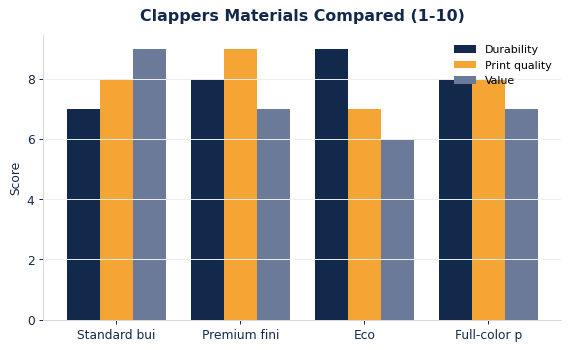
    The common materials for custom clappers each trade off durability, print quality, and cost: standard build, premium finish, eco / recycled, and full-color print surface. The right pick depends on how the clappers will be used, the look you want, and your budget. The chart and table below compare the main options so you can match material to job.

    How common clappers materials compare on durability, print quality, and value.
    How common clappers materials compare on durability, print quality, and value.

    As a rule of thumb, choose a recyclable or natural material when eco positioning matters, a coated or laminated option when you want vivid full-color print, and a premium build when the clappers is part of a gift or high-end presentation. When in doubt, request a sample so you can judge feel and print before committing to a full run.

    Material / option Best for
    Standard build reliable, cost-effective for high-volume swag
    Premium finish soft-touch or upgraded feel for gifting
    Eco / recycled sustainable option that signals brand values
    Full-color print surface vivid, edge-to-edge branding area

    Sizing and specs

    Sizing is where many clappers orders go wrong, so measure before you order. Custom clappers typically range from a compact giveaway up to a larger statement piece, and the right size and format depends on the product or use they serve. Too small and the fit is tight or the product is exposed; too large and you pay for material you do not need and lose a clean, intentional look.

    When a measurement falls between standard options, size to the product with a small margin rather than guessing. Confirming the size and format on a proof or sample before a large run prevents the costly mistake of a full order that does not fit, which is far more expensive to fix than a five-minute check up front.

    Branding and decoration

    Decoration is what turns a plain clappers into a branded one. Pad printing and full-color wraps place logos vividly, with engraving or embossing for an upscale, permanent mark. Match the method to your artwork and budget: simple logos reproduce cleanly and cheaply, while detailed, full-color designs shine with the right process on the right material. Keep the artwork vector where possible and confirm the print area for your chosen size.

    Restraint usually reads as premium. A clean logo, one or two brand colors, and quality material almost always look more considered than a busy, over-printed design. Approving a proof before the run protects both the look and the budget, especially on a large order of custom clappers.

    Ordering and budget

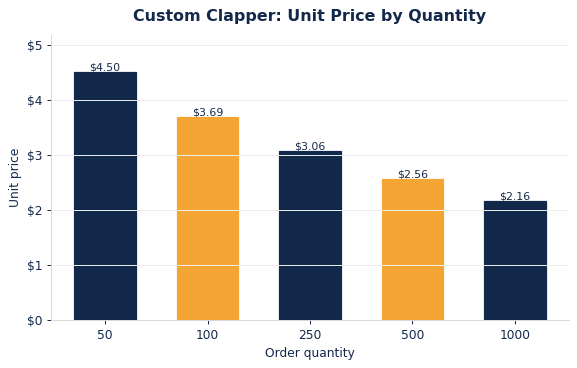
    Per-unit cost on custom clappers falls steadily with volume as setup amortizes across more pieces, so ordering for real demand rather than a token first batch is usually the efficient move. The curve below shows how pricing typically improves with quantity, which helps you plan an order that balances cash and cost.

    Typical per-unit clappers pricing as order quantity increases.
    Typical per-unit clappers pricing as order quantity increases.
    Ordering for a recurring need? A single larger run lowers the unit cost and keeps your branding consistent, while a small overage covers reorders and the occasional damaged piece without a rush order.

    Common mistakes to avoid

    A few avoidable missteps account for most disappointing clappers orders. Ordering before measuring is the biggest, followed by choosing a material for price alone without considering how the clappers will actually be used, and skipping the proof on a large run. Each is easy to prevent with a few minutes of planning, and each is expensive to fix once a full order is produced.

    The other common trap is over-designing the artwork. Cramming in too many colors, effects, or details can muddy the print and raise the cost, especially on textured or recycled materials. Simplifying the design to a clean, legible mark almost always improves both the look and the price of your custom clappers.

    Frequently asked questions about custom clappers

    What material is best for custom clappers?

    It depends on the use: choose a recyclable or natural material for eco positioning, a coated or laminated option for vivid full-color print, and a premium build for gifting or high-end presentation. Request a sample to judge feel and print before a full run of custom clappers.

    How do I choose the right size?

    Measure the product or use the clappers serves, then size to it with a small margin so the fit is clean without wasting material. When a measurement falls between standard options, size up slightly and confirm the size and format on a proof before ordering in volume.

    How are custom clappers branded?

    Pad printing and full-color wraps place logos vividly, with engraving or embossing for an upscale, permanent mark. Match the method to your artwork and budget, keep the art vector where possible, confirm the print area for your size, and approve a proof so the finished custom clappers match your intent.

    How does pricing work, and is there a minimum?

    Per-unit cost drops with quantity as setup amortizes across the run, so larger orders are more cost-effective. Order for real demand plus a small overage rather than a token batch, and consolidate recurring needs into one run for the best price.

    Can I get a sample or proof before ordering?

    Yes, and it is strongly recommended. A physical sample lets you judge material and print, and a digital or physical proof confirms your artwork, color, and size and format before a full run — a small step that prevents a costly mistake on a large order.

    What do you need to quote custom clappers?

    To quote accurately we need the size and format or the product they serve, the quantity, your material preference, and your artwork or a description of the branding. With those details we can recommend the right material and size and give you pricing for the run, and a proof follows once the order is confirmed.

    Whatever you order, send vector artwork, confirm material and size and format, and approve a proof before production. For help matching custom clappers to a specific use, see our companion guide, our How to Choose Custom Clappers for Your Brand, and explore our our shop to start your order.

    Ready to order custom clappers?

    Tell us your product, quantity, and branding and we’ll match the material, size, and decoration for you.

    Get a Quote

  • Custom Thundersticks: Buyer’s Guide to Branded Cheering Clappers

    Custom Thundersticks: Buyer’s Guide to Branded Cheering Clappers

    Custom Thundersticks: The Buyer’s Guide to Branded Cheering Clappers

    Few giveaways turn a quiet crowd into a wall of noise faster than a pair of inflatable clappers. Custom thundersticks, the long balloon-like bang sticks fans smack together at games, pep rallies, and political events, are one of the highest-energy branded items you can put in a crowd’s hands. They are cheap per unit, impossible to ignore, and printed edge to edge with your team colors, logo, or campaign message. This guide covers what actually matters when you order custom thundersticks: material and thickness, size, printing, safety, and how to hit the right price break for your crowd size.

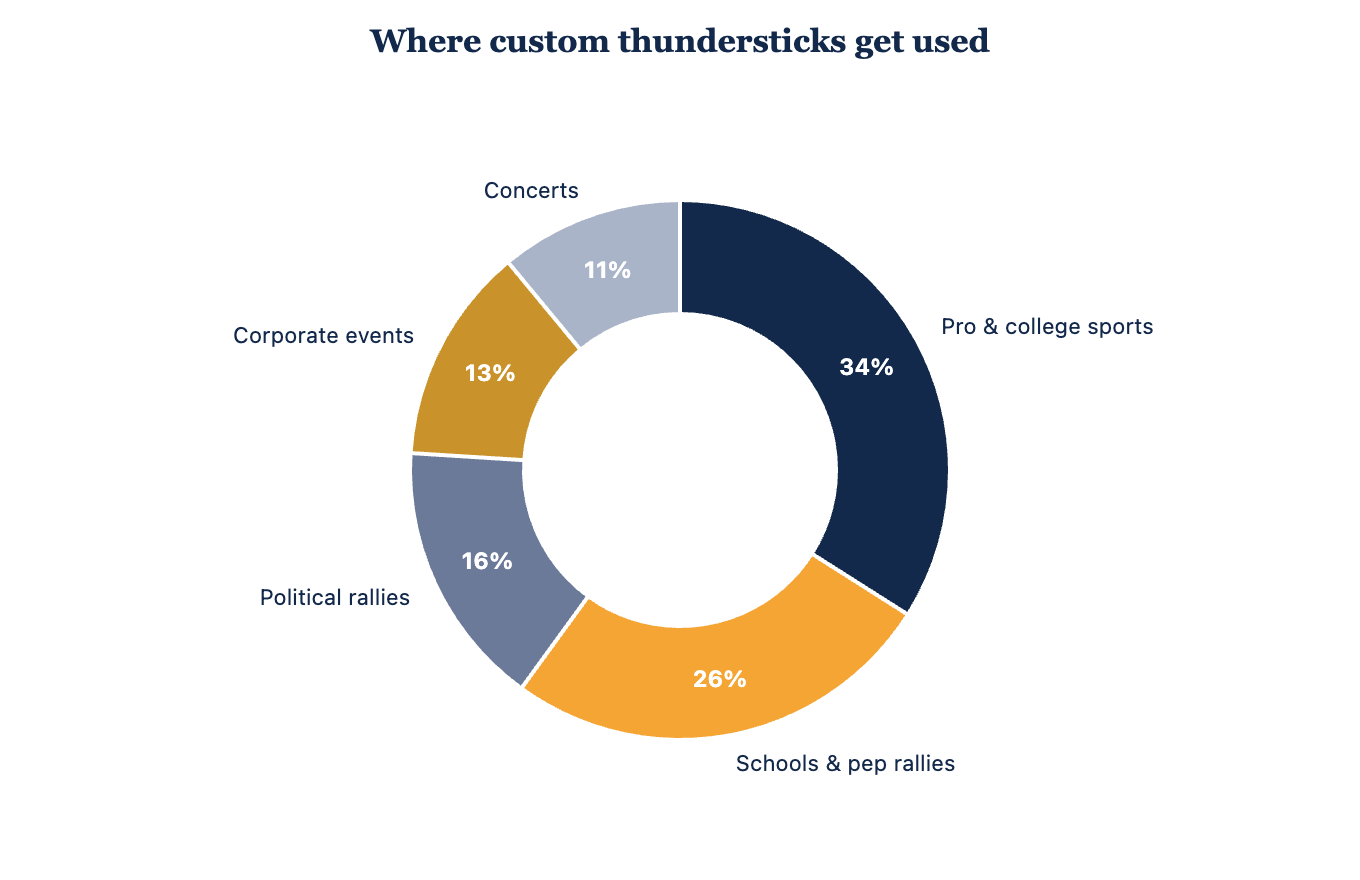
    Because they are noisy, visible, and inexpensive, custom thundersticks are a favorite of athletic departments, booster clubs, schools, and rally organizers who need thousands of them and need them to survive an energetic crowd without splitting on the first hit.

    Share of custom thunderstick orders by event type
    Where custom thundersticks show up most, by share of orders.

    How thundersticks make their noise

    A thunderstick is essentially a long, sealed plastic tube inflated with air. When two of them collide, the trapped air produces that signature loud bang. The sound quality and durability come down to the film: thicker plastic bangs louder and resists puncture, while thin economy film is cheaper but splits faster under enthusiastic use. Most sticks are sold and used in pairs, so remember you are buying two per person when you plan quantities.

    Film thickness matters most

    Thickness is measured in microns. Budget sticks run thin and are fine for a short, controlled event like a school assembly. Standard-weight film is the reliable middle ground for a full game or rally. Heavy-duty film costs more but survives repeated hard hits and rough handling, which is what you want for a rowdy student section or a multi-hour event. If your crowd skews energetic, spend up on thickness, it is the single biggest driver of whether your sticks last the whole event.

    Size and shape options

    The standard thunderstick is roughly 24 inches long, big enough to see across a stadium and to print a real message on. Shorter sticks are easier to pack and cheaper to ship but quieter and less visible. Beyond the classic tube, suppliers offer die-cut shapes, foam fingers, number ones, and cartoon hands, that turn the stick into a recognizable silhouette. Custom shapes cost more and take longer, but for a signature look, like a giant foam mascot hand, they are unbeatable.

    Printing your design

    The long, curved surface of a thunderstick is prime advertising real estate. Full-wrap printing lets your logo, hashtag, or sponsor mark run the entire length so it reads clearly even when the sticks are waving. Bold, high-contrast art works best, fine print and thin lines get lost in the motion and the curve. Team names, jersey numbers, and single sponsor logos are the sweet spot. Decide whether one side or both sides need printing, since two-sided printing raises the cost but doubles visibility in a waving crowd.

    Tip: a thunderstick is seen in motion, not held still. Design for a distance read, one big word, one strong color block, one clean logo. Save the fine print, sponsor rosters, and event details for a different giveaway, because none of it survives being waved around a stadium.

    What custom thundersticks cost

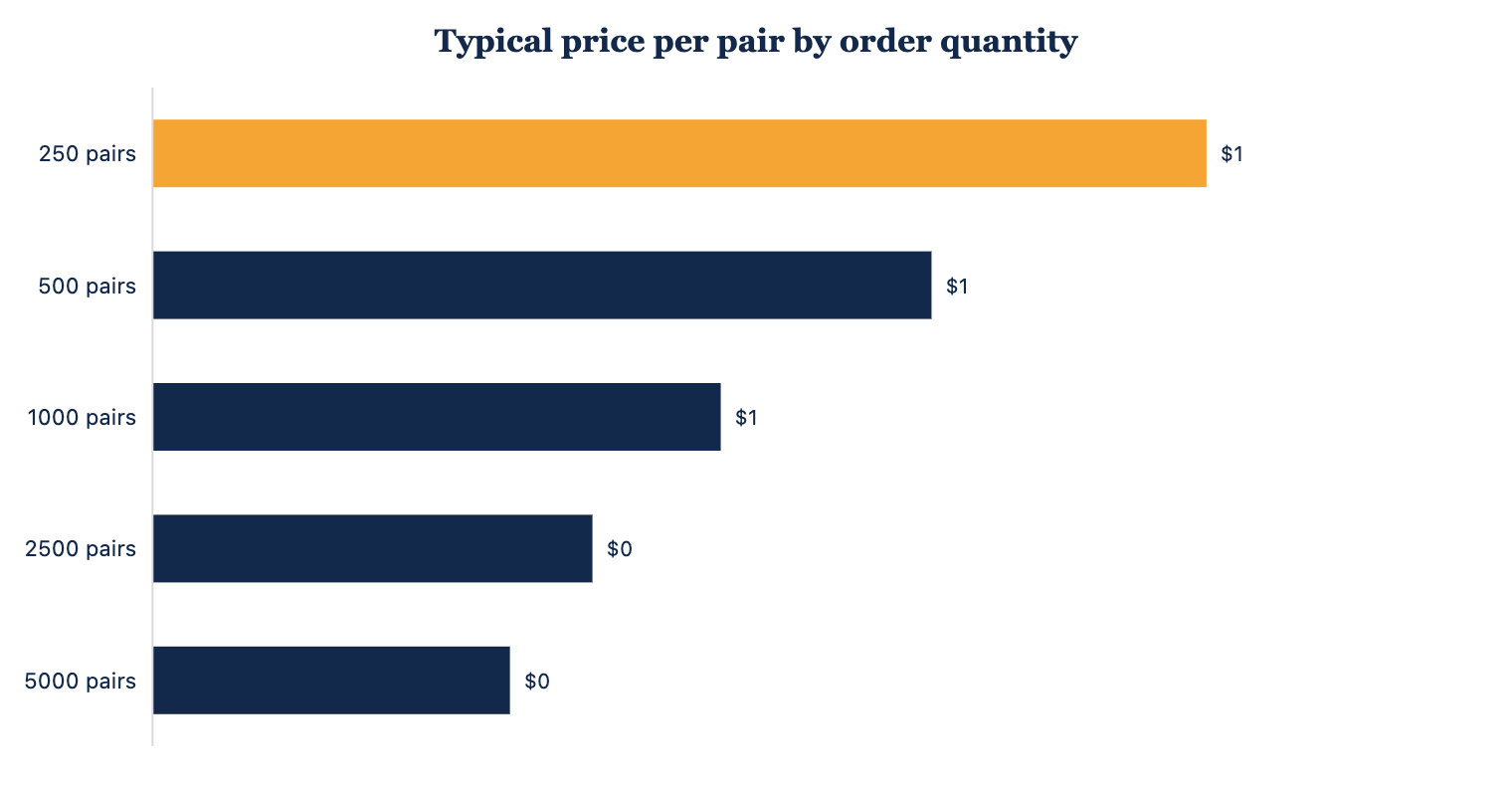
    Thundersticks are one of the cheapest per-unit noisemakers available, and the price drops steeply with volume. Because they ship flat and inflate on site, freight stays low even for big orders. The chart below shows a typical per-pair price curve so you can size your order to land just above a price break rather than just below it.

    Typical per-pair thunderstick price falling as order quantity rises
    Typical custom thunderstick price per pair by order quantity.

    Matching sticks to your event

    The right spec depends on how hard your crowd will use them and how long the event runs.

    Use caseFilm weightLengthWhy
    School pep rallyEconomy18-24 inShort, controlled, budget-driven
    College student sectionHeavy-duty24 inRowdy, multi-hour, high abuse
    Pro sports promo nightStandard24 inBig volume, sponsor-printed
    Political rallyStandard24 inVisible message, TV-friendly
    Corporate / concertStandard24 inBrand moment, photo-ready

    Safety and compliance

    Thundersticks are handed to big crowds including kids, so the basics matter. Look for lead-free, phthalate-safe inks and film, and confirm the supplier meets the safety standards for your region. The sticks should inflate and seal cleanly with no sharp edges. For events with young children, some organizers add a printed safety line reminding people not to swing sticks near faces. It is a small thing that heads off the one predictable complaint.

    Inflation and handout logistics

    Sticks ship flat and are inflated on site by mouth or with a small pump. For large crowds, plan the labor: pre-inflating thousands of pairs takes time, so many venues inflate in batches right before doors or hand out flat sticks with a quick how-to. A small pump station speeds things up dramatically for volunteer teams.

    Lead times and ordering smart

    Standard tube sticks on stock sizes turn around quickly, while custom die-cut shapes and two-sided full wraps need more production time. Order early for a scheduled game or event date and always approve a proof for color and logo placement first. Since sticks are used in pairs and a few always fail, order a comfortable buffer over your expected attendance rather than an exact headcount.

    Reusable and eco-friendly options

    Standard thundersticks are single-event items, but greener choices exist. Some suppliers offer recyclable film or thicker, reusable sticks that fans can keep and bring back to the next game, which suits season-ticket bases and schools that run repeat events. Recyclable film costs a little more and prints just as vividly, so if sustainability is part of your brand story it is an easy upgrade to specify. For any reusable program, lean toward heavy-duty film, a stick meant to come back needs to survive being tossed in a bag and used again.

    Storing leftovers between events

    Because sticks ship and store flat, leftover inventory is easy to keep for the next date. Deflate and stack them in a dry box away from heat and sunlight, which degrade the film and the print over time. A little organized storage means one big order can cover several events in a season and push your effective per-use cost even lower.

    The bottom line

    Great custom thundersticks come down to the right film thickness for how hard your crowd hits, a size that reads across the stadium, and bold art designed for a distance. Spend up on heavy-duty film for rowdy sections, keep the design simple and high-contrast, confirm the safety credentials, and plan your inflation labor. Do that and you will turn any crowd into a branded wall of noise for a few cents per hand.

    Design your custom thundersticks

    Tell us your crowd size, event date, and artwork and we will spec the film weight, size, and print that fit your budget.

    Get a Quote

    Home · About · Buying guides