Walk into any team store or event-supply catalog and the noisemaker aisle looks interchangeable: everything is loud, everything takes a logo, and everything is cheap by the case. The differences only surface once you are staring at a purchase order for two thousand units with an event date three weeks out. Inflatable thundersticks, molded hand clappers, megaphones, and horns each make noise a different way, print a different way, and ship a different way, and those three factors decide which one belongs at a stadium giveaway, a school pep rally, or a corporate 5K.
This is a side-by-side look at the noisemakers most often ordered with custom printing, what actually separates them, and how to read a quote so the numbers make sense before you commit.
How each one actually makes noise
Inflatable thundersticks come as a pair of long plastic tubes, roughly 24 inches by 4 inches (about 60 by 10 cm) each. You inflate them through a small valve, then bang the two together to produce the sharp crack that gives them their name. They fold flat when deflated, which is why overseas suppliers can ship them by air express, and they are reusable across a season. Molded hand clappers are the classic spirit item: a three-piece plastic assembly with a hinged hand on a handle that you shake back and forth to clap. They cost almost nothing and need no setup from the user. Clacker paddles work on the same shake-to-strike principle but with a flat paddle face that gives you more room for artwork. Megaphones are rigid plastic cones that amplify a voice rather than generate their own sound, and stadium horns (including vuvuzela-style horns) push a single loud tone through a mouthpiece.
One honest caveat: published decibel figures for these products are scarce and largely meaningless in isolation, because the effect that matters is collective. A single thunderstick is modest; several thousand fans banging them on the same beat is what rattles an opposing quarterback. Treat loudness as a function of crowd size and coordination, not a spec you can put on a data sheet.
What custom printing looks like on each
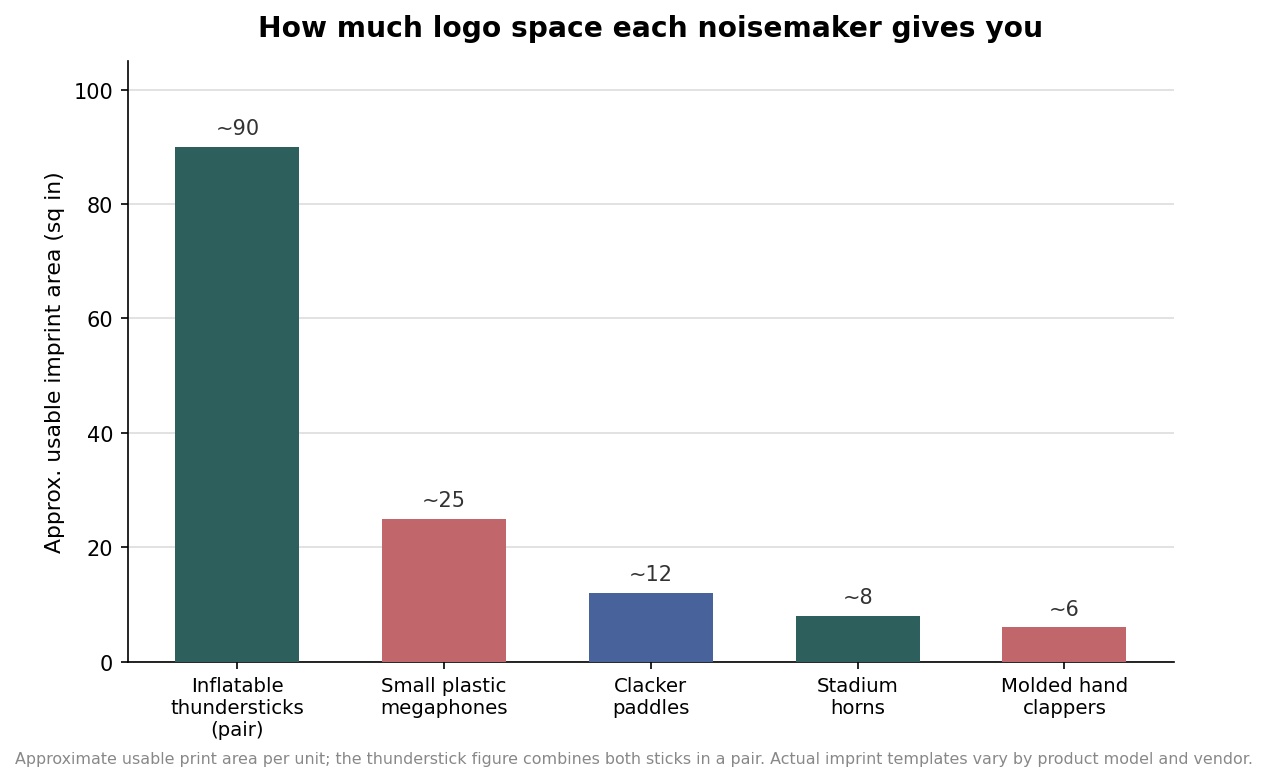
For a buyer whose whole reason to order is the logo, print area is the spec that quietly matters most. Thundersticks give you the largest canvas by far: two long flat panels per pair, easily the biggest imprint in the category, with full-color, metallic, and even light-up versions available from many suppliers. Molded hand clappers sit at the opposite end, with only a small paddle or hand surface to work with, so a busy logo has to be simplified. Clacker paddles and megaphones fall in between, with the megaphone’s curved cone printing as either a wrap or a single panel.
Color count drives cost more than area does. Most of these products are screen or pad printed, and each ink color needs its own plate and press pass, so a clean one- or two-color mark keeps unit pricing and setup fees down. Full-color process printing is available on thundersticks and some megaphones but carries a higher setup. The rough imprint areas below explain why the same logo can look crisp on a thunderstick and crowded on a hand clapper.
Cost, quantities, and lead time
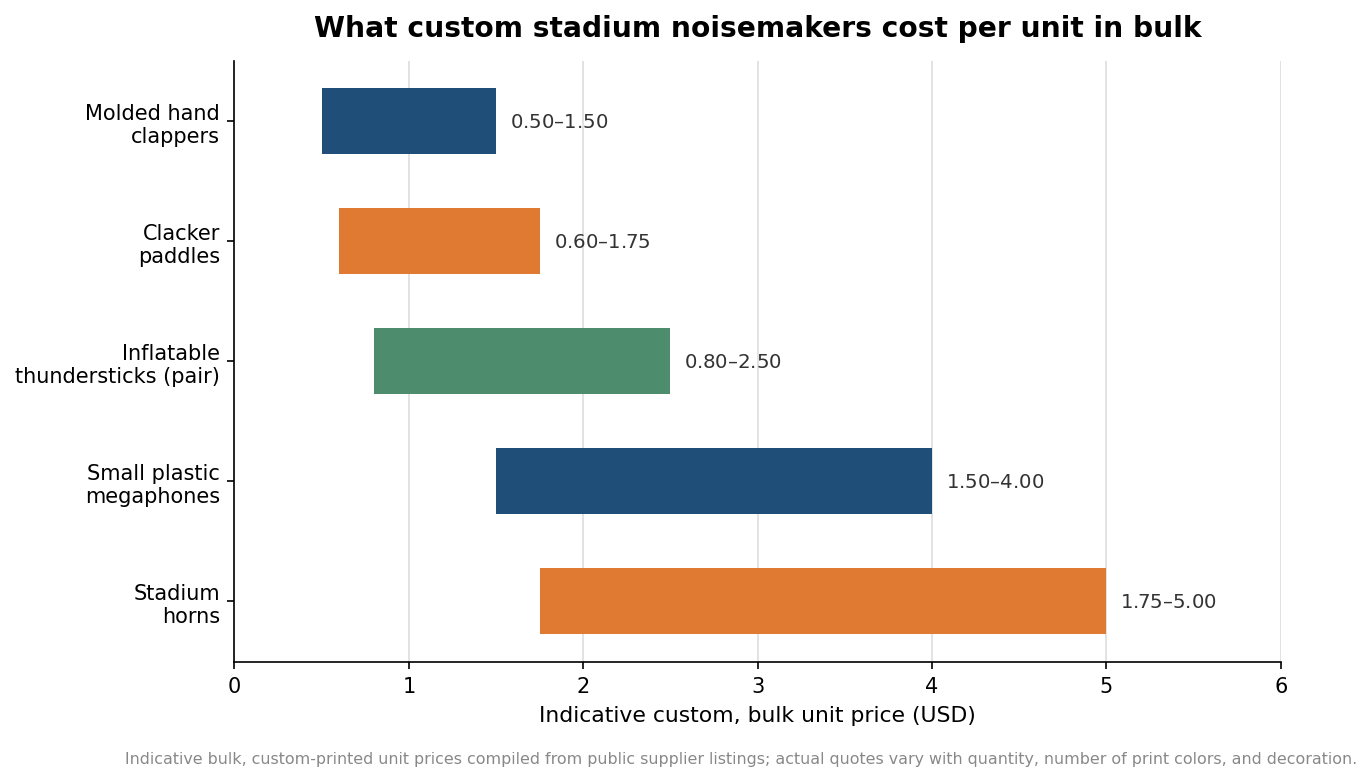
Molded hand clappers are historically the cheapest spirit noisemaker, often quoted well under a dollar in volume, which is why booster clubs and campaign teams lean on them. Thundersticks run a little more per pair once you add custom printing, and megaphones and horns cost more still because they use more rigid plastic. The bands below are indicative market ranges pulled from public supplier listings; your actual number moves with quantity, color count, and any premium decoration.
Minimum order quantities commonly start around 100 to 250 pieces for custom work, with per-unit price dropping meaningfully as you move into the thousands. Expect a one-time plate or setup charge per color on top of the unit price. Production time is typically in the two-to-four-week range after art approval, plus transit, though rush programs exist and folded thundersticks move quickly by air. If any of those figures is a hard constraint for your event, confirm it in writing before you approve art, because an in-hands date is the one variable a low unit price cannot rescue.
Matching the noisemaker to the event
For a large arena giveaway where the sponsor wants its mark seen on television, thundersticks are hard to beat: big imprint, visible motion in the stands, and real crowd noise. For a school or booster group on a tight per-unit budget, molded hand clappers deliver spirit-item economics and need no inflation step, which matters when volunteers are handing out thousands at a gate. When the goal is a voice carrying rather than ambient roar, such as a cheer squad or an announcer working a crowd, a megaphone is the right tool. Horns and cowbells earn their place as novelty items that make a brand feel distinct, though horns deserve a caution around young children and enclosed spaces because a tone blown at close range can be genuinely uncomfortable.
Indoor versus outdoor also steers the decision. Inflatables and molded plastics are forgiving in rain and easy to clean up afterward, while anything requiring the user to blow into a mouthpiece raises hygiene questions for shared or reused units. Cleanup volume is worth a thought too: a pair of thundersticks per fan is twice the post-event litter of a single clapper.
Specifying the order so it arrives right
Whatever you choose, a clean order starts with vector artwork rather than a low-resolution logo pulled from a website, spot colors called out in Pantone (PMS) values so the ink matches your brand, and the exact imprint dimensions and number of print colors stated up front. Decide whether you need one-sided or two-sided printing, since a second side is effectively a second imprint and is priced accordingly. Ask for a physical or digital proof and approve it deliberately, because the proof is your last checkpoint before a few thousand units are committed. Then work the calendar backward from your event, adding transit and a buffer to the quoted production window. Get the specs right on paper and the noise takes care of itself on game day.
Leave a Reply