Hand clappers are one of the cheapest branded noisemakers you can put in a crowd’s hands — a stock 7.5-inch plastic clapper with a one-color logo runs around a dollar and a half at modest quantities. But cheap does not mean foolproof, and the same handful of mistakes shows up in clapper orders over and over: artwork that cannot possibly fit, orders placed just below a major price break, budgets that forget the fees, timelines that confuse production with delivery, and boxes of noisemakers that a venue will not allow through the door. Here is each mistake and how to avoid it.
Mistake one: designing for the clapper, not the imprint area
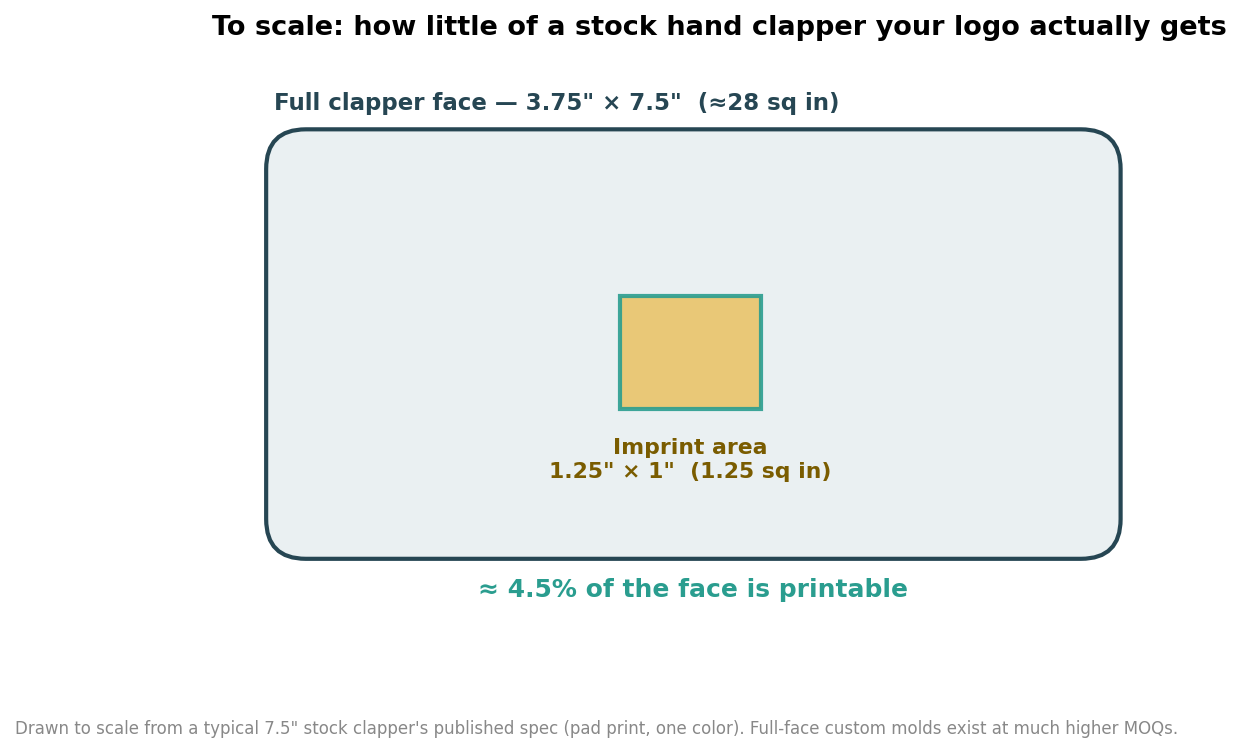
The printable area on a stock clapper is startlingly small. A typical 7.5-inch clapper measures about 3.75 by 7.5 inches across the face, but the published imprint area is roughly 1.25 by 1 inch — about 4.5 percent of the surface you see in the product photo. That is because stock clappers are pad-printed or screen-printed on a curved, molded surface, and the flat printable window is limited. Full-color mockups with wraparound art belong to full-face custom-molded clappers, which exist but at far higher minimums and tooling costs. For a stock order, design for the window: a simplified logo mark or short wordmark in one color, no fine detail, no small type. If your logo has a complex gradient or a long tagline, fix that before you upload art, not after the proof comes back.
Mistake two: ordering just below a price break
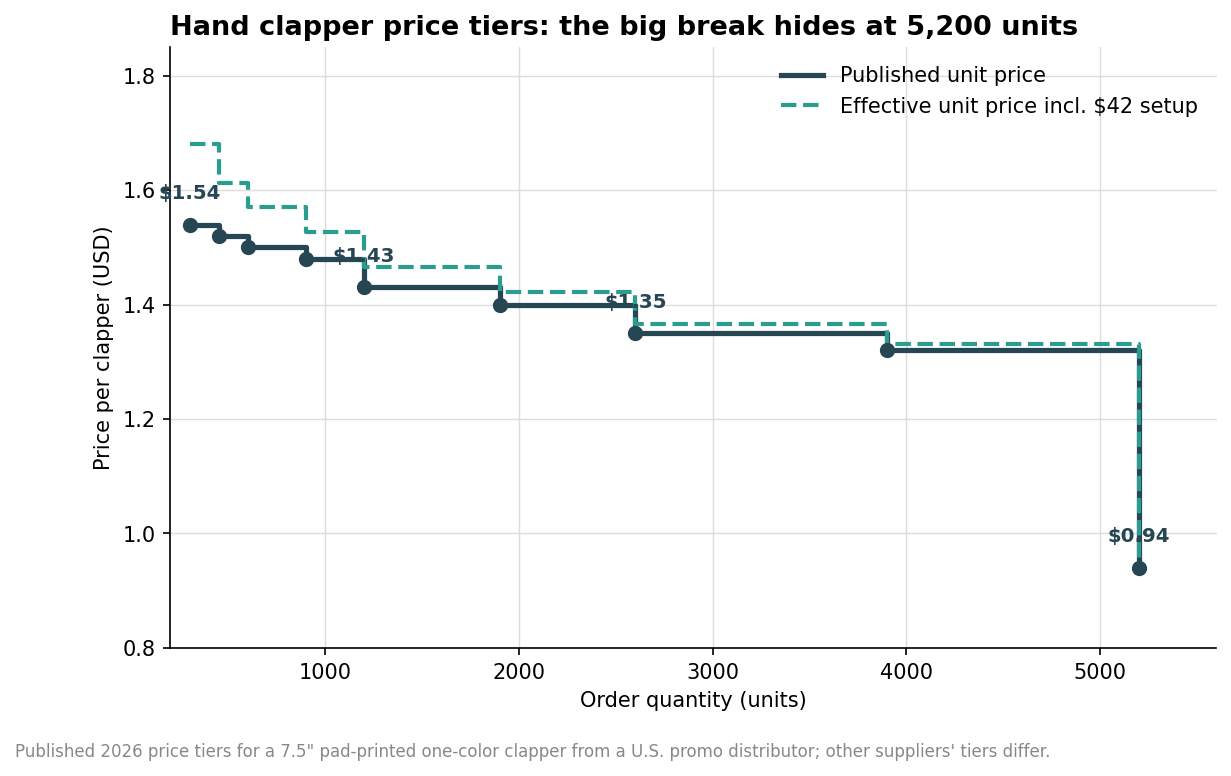
Clapper pricing steps down in tiers, and the steps are not evenly spaced. One large U.S. distributor’s published tiers for a 7.5-inch one-color clapper run from $1.54 per unit at 300 pieces, drifting down a few cents per tier through $1.32 at 3,900 — and then dropping to $0.94 at 5,200 units, a 29 percent cut in one step. A buyer ordering 4,500 clappers at $1.32 pays about $5,940; ordering 5,200 at $0.94 costs about $4,888 — 700 more clappers for a thousand dollars less. Not every supplier’s cliff sits at the same quantity, but nearly every supplier has one. Before you finalize a quantity, ask for the full tier table and check whether the next break up costs less in total than the quantity you planned.
Mistake three: budgeting the unit price and nothing else
The unit price is not the invoice. Typical published extras: a setup fee of about $40 to $42 per imprint color, additional imprint colors around 35 cents per unit where offered, second-side printing billed separately, and color matching around $10 per color if your brand blue has to be exact. On a small 300-unit order, a $42 setup fee alone adds 14 cents to the effective cost of every clapper, and a two-color, two-sided imprint can push the real per-unit cost 50 percent above the advertised number. None of these fees are hidden — they are on the quote if you read it — but they surprise buyers who compared suppliers on the headline unit price alone. Compare total delivered cost for your exact spec, including setup, extra colors, and freight.
Mistake four: confusing production time with arrival time
Promo distributors advertise fast production on stock clappers — some publish two-day or even one-day production once artwork is approved — and buyers hear “two days” as “in hand in two days.” Production time starts after your art is approved, which itself takes a proof cycle of a day or two, and shipping is on top: ground freight for a few thousand clappers is bulky and can add most of a week depending on distance. Realistic door-to-door timing for a standard order is one to two weeks, with rush options compressing production but not the truck. These are indicative figures; the practical rule is to work backward from the event date, subtract shipping and a proof cycle, and treat the advertised production window as the smallest piece of the timeline, not the whole of it.
Mistake five: never asking whether the venue allows them
The most expensive mistake is the one where everything ships perfectly and security confiscates the clappers at the gate. Artificial noisemakers are restricted or banned in plenty of settings — many arenas and school athletic associations prohibit them at indoor events, and championship-level events often have explicit no-noisemaker policies. Rules vary venue by venue and league by league, so verify in writing with the specific venue before you order, not after. If clappers are out, the same budget usually shifts cleanly to items the venue does allow — rally towels, foam hands, or LED wristbands — and a supplier who prints all of them can requote quickly. Five minutes of checking protects the whole spend.
One more habit separates smooth orders from scrambles: order a physical sample first. Most distributors will sell or send a blank sample for a few dollars, and holding one answers questions no product page can — how loud the clack actually is, how the plastic feels, whether the color matches your brand palette in daylight, and how your simplified logo reads at imprint size. On a multi-thousand-unit order, a one-week sample detour is cheap insurance against a garage full of noisemakers that disappoint.
None of these mistakes come from bad suppliers; they come from ordering a familiar-looking product without reading its actual spec. Check the imprint window against your art, find the price cliff, total the fees, build the timeline backward from event day, and clear the venue rules — do those five things and a clapper order is about as low-risk as promotional printing gets.
Leave a Reply